Surgam

The Philolexian Foundation
In service to the Philolexian Society of Columbia University · Founded MDCCCII
In service to the Philolexian Society of Columbia University · Founded MDCCCII
About · I.
Two and a Quarter Centuries of Argument, Verse, and Good Company.
The Society began as a King's College literary society founded in the 1760s which counted among its members Gouverneur Morris and Alexander Hamilton (both later signers of the U.S. Constitution). Interrupted by the Revolutionary War, it continued under the name Columbia College Society for Progress in Letters by students including Daniel D. Tompkins (later Vice President under James Monroe), and was officially codified by Hamilton's son, James Alexander Hamilton (Columbia College Class of 1805), who chose the name The Philolexian Society on May 17, 1802.
For most of the nineteenth century the Society ran debates, essay contests, correspondence, and public speeches. Membership was capped, in those years, at forty. To accommodate freshmen (initially ineligible) the rival Peithologian Society was formed in 1806; the two would compete for a hundred years, and in the process give Columbia its school colors. Philolexian Blue and Peithologian White descend from the two societies — never disputed, though never acknowledged, nor compensated.
At the 1852 semi-centennial, alumni raised a prize fund of more than $1,300 endowing annual prizes in Oratory, Debate, and Essay. Those awards eventually merged into the Philolexian Prize, administered by Columbia's English Department since the 1950s. During Columbia College's tenure on the 49th Street campus (1857–1896), Philo often met in an old paper factory in the northeast corner of the grounds.
Philolexian produced an unusual concentration of literary talent through the early twentieth century. The essayist Randolph Bourne (1912), the poet Joyce Kilmer (1908), and the diplomat V. K. Wellington Koo (1908) all passed through in the first generation. In 1910 the Society began a twenty-year run of annual theatre productions including North American debuts of Ben Jonson, Nicholas Udall, and Robert Greene; the Oscar-winning screenwriter Sidney Buchman (1923) got his start playing Shakespeare's Richard II in a Philo production.
The next cohort included Herman J. Mankiewicz (1917), who would co-write Citizen Kane two decades later; James Warner Bellah (1923), whose stories formed the basis for John Ford's cavalry trilogy and The Man Who Shot Liberty Valance; the novelist Herman Wouk (1934 — Pulitzer for The Caine Mutiny, later The Winds of War); and the Pulitzer poet John Berryman (1936). Philolexian in the late 1930s was, by one account, “devoted mainly to drinking wine and listening to jazz.” The Society records this without embarrassment. One Philolexian of that era won a Grammy for his liner notes to Thelonious Monk. Beyond the writers, the Society's rolls have included a long parade of judges, ambassadors, governors, and college presidents — the full reckoning is in the sidebar.
By the late 1940s the early Beat circle had passed through Hartley Hall and the Society's weekly meetings. Allen Ginsberg (1948) presided as Moderator alongside his fellow Philolexians Lucien Carr and Jack Kerouac. The friendships formed in the Society would, in due course, become the Beat Generation.
While Philo has had its share of writers feted by the literary elite, the Society also counts among its members workaday writers and editors — figures who ran publishing houses such as Harcourt Brace, Doubleday, Simon & Schuster, and Knopf, and have written blockbusters such as Some Like It Hot and Die Hard 2.
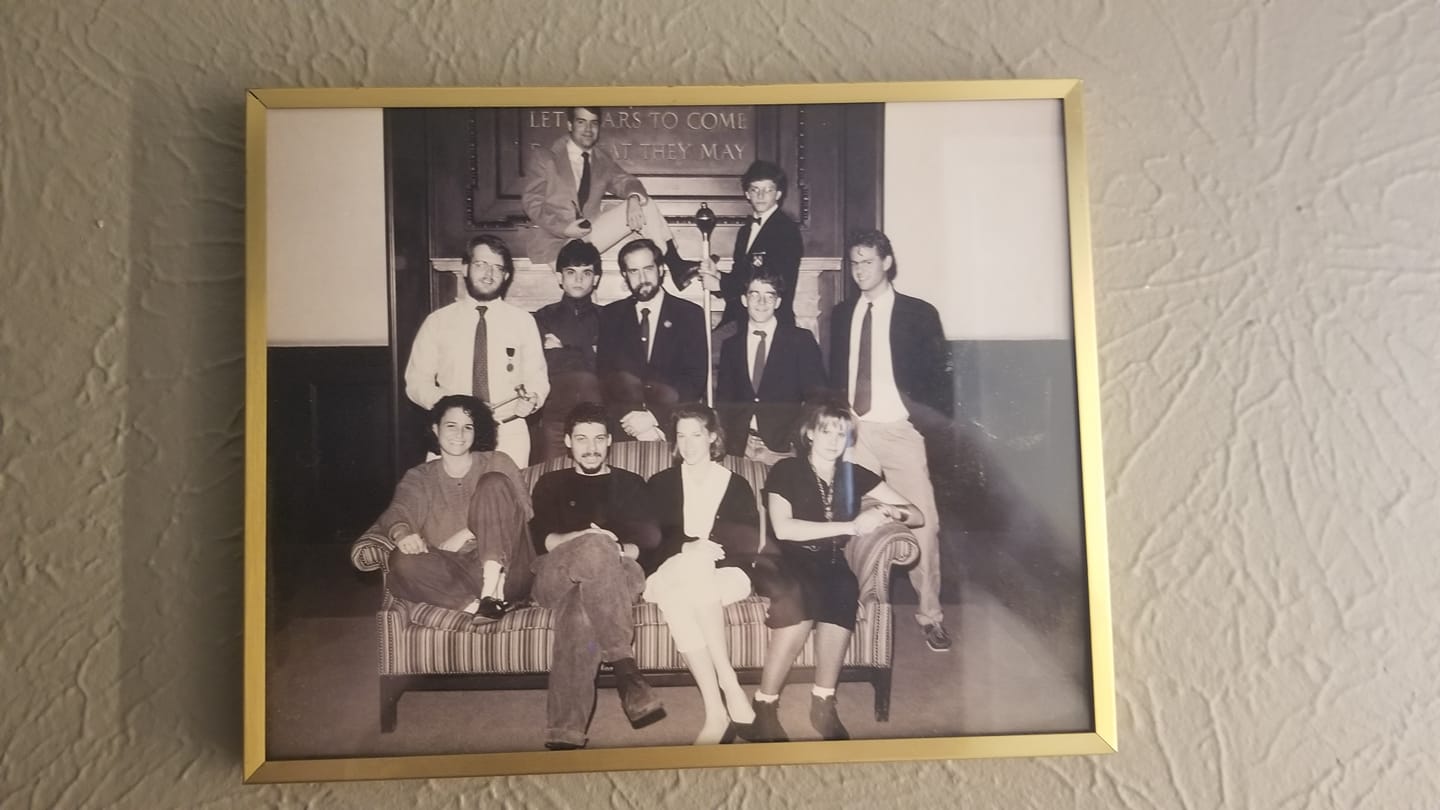
On Wednesday, October 16, 1985, a group of iconoclasts under the leadership of Thomas J. Vinciguerra (Class of 1985) reinstituted the Society after a brief hiatus and brought it back to its founding roots. Vinciguerra was subsequently designated the Society's "Avatar" in recognition of his continued thirty-year effort to nurture the Society into one of Columbia's most beloved student institutions.
On Saturday, October 16, 2010, Philo celebrated the twenty-fifth anniversary of its revival with a meeting and reception called Resurgam 25. The resolution: "Resolved: The Philolexian Society Has Never Had It So Good" was overwhelmingly approved.
The Society holds constitutional conventions periodically to keep its founding document current, though many suspect the conventions are called as an excuse to imbibe the constitutionally required Black and Tans at the gathering. Hence, there have been an extraordinarily large number of Constitutional Conventions. The Society meets every Thursday during the academic term and runs a calendar of awards, dinners, contests, and travel substantially recognizable to a Geezer of any era.
The First Hundred Years (1802–1902). A complete narrative history of the Society was written for its centenary: A History of the Philolexian Society of Columbia University, 1802–1902, by Ernest A. Cardozo (CC 1899). The full text is in the public domain and held by the Internet Archive. Read it (PDF) →
The First Postcentennial Decade (1902–1912). Philolexian Annals 1902–1912 (1912): the Society's own sequel to the Cardozo history, with a recap of the Centennial celebration, an essay on the Society's rise to campus leadership, the Constitution and Bylaws, prize records, debate ledgers, plates of the first two Philolexian Plays, and the full class-roll 1802–1912.
The Barzun Compilation (1912–1927). Samplings and Chronicles, Being the Continuation of the Philolexian Society History, With Literary Selections, From 1912 to 1927, edited by Jacques Barzun (1927): mostly essays — a foreword by John Erskine, chapters on changing forms of Philo activity, an anthology of writing by Philos, a Philolexicon index, notes on seventeen Philolexian Plays, and the roll of members 1913–1927.
The Second Hundred Years (1902–2002). A volume covering the Society's second century is currently being prepared by the Foundation.
The Third Hundred Years (2002–). Being lived.
The Philolexian Quick Time March. Published in New York in 1854 by Harvey B. Dodworth (bandmaster of the Dodworth Band and the 13th Regiment Band of the New York State Militia, and the leading American brass-band figure of his day) written for the Society and named after it. Sheet music (PDF) →
The Philolexian Ditty. A drinking song of the Society, set (in the manner of the era) to the tune of the German student anthem “Krambambuli.” Recovered from the inside cover of a Philolexian anniversary dinner program, ca. 1915. Sheet music (PDF) →
The Foundation stewards funds for the student Society, the awards program, and the search for a permanent home. Every gift is tax-deductible.
Donate