Surgam

The Philolexian Foundation
In service to the Philolexian Society of Columbia University · Founded MDCCCII
In service to the Philolexian Society of Columbia University · Founded MDCCCII
Members & Alumni · V.
The rarefied pantheon of Philolexians who have been rendered, in the fullness of time, as cocktails.
The Society has long since ceased to be surprised by the honors its members accumulate. Academy Awards, Pulitzers, university presidencies, ambassadorships to countries most Philolexians can barely spell, patents for inventions they can barely pronounce — all of these have been achieved by Society members, sometimes by the same one. And yet one honor towers above the rest. The founding documents speak of those whose distinction in letters and oratory has brought “honor to the Society and lustre to its traditions.” There is, however, a higher distinction: to be immortalized as a drink.
By the current count, exactly three Philolexians have achieved this rare distinction. What follows is their pantheon.
The following account first appeared in the Foundation's newsletter under the title “Yet Another Philo Potable” by Thomas J. Vinciguerra (CC '85), the Society's Avatar, and is reproduced here verbatim.

Brander Matthews, CC 1871, L 1873, left a major impact on American letters, but little of his legacy remains, at least on campus. Matthews was the country's first professor of dramatic literature, a renowned scholar and critic who was also a playwright, famous for his dedication to the notion that drama must be seen and heard, not merely read. At Columbia he established a four-room museum in Philosophy Hall containing books, scripts, costumes, props and even dioramas of such famous playhouses as the Globe; the University's theater on 117th Street was named for him. But after his death in 1929, the museum was broken up and its contents dispersed and the theater was razed. Even Matthews' oil portrait, which long graced a seminar room in Philosophy Hall, has been stolen.
Matthews does live on in a bronze bust in the office of College Dean Emeritus Austin Quigley, who holds his namesake academic chair. And he is immortalized in a drink. Matthews was one of the original incorporators of the Players, the private literary and theatrical club on Gramercy Park founded by Edwin Booth, and the club elected him to headline a new series of cocktails named for famous members. The “Brandy Matthews” was created by famed mixmaster Dale DeGroff, founder and president of the Museum of the American Cocktail, based in New Orleans, which, coincidentally, was Matthews' hometown.
Assemble the ingredients, save the garnish, in a cocktail mixing glass with ice. Stir to chill and strain into a chilled cocktail glass. Twist a wide curl of orange zest over the drink to express the oils, then drop the curl in.
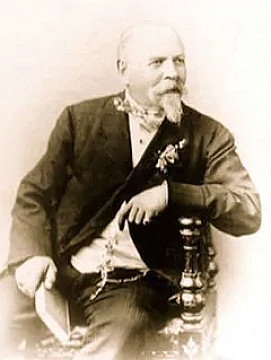
Sam Ward, Columbia College 1831, remembered by the trade as the “King of the Lobby,” managed the impressive feat of becoming Washington's most influential lobbyist without ever formally lobbying anyone. His method, refined through the Grant administration and beyond, was to feed and water the politicians of the day so magnificently at his Capitol Hill dinners (canvasback duck, terrapin, and a strict prohibition against talking business at the table) that his opinions, offered casually over dessert or a final glass of something, could not fail to prevail by morning. He is generally credited with inventing the modern Washington influence dinner as a genre.
The particular irony of Ward's career deserves noting. His father, Samuel Ward Sr. (the Wall Street banker of Prime, Ward & King, who reared him at 16 Bond Street) was one of the founders of the New York Temperance Society and served as its first president. The son took this, and much of what followed, as a challenge.
The cocktail that bears his name, still poured in the attentive New York bars, is Ward's whole aesthetic in a single glass: elemental, generous, and rather stronger than it looks.
Fill an old-fashioned glass with crushed ice. Curl a long strip of lemon zest around the inside of the glass so that it lines the interior wall. Pour the Chartreuse over the ice. To be sipped slowly, as Ward would insist. Green Chartreuse may be substituted, at the price of a slight loss of dignity.
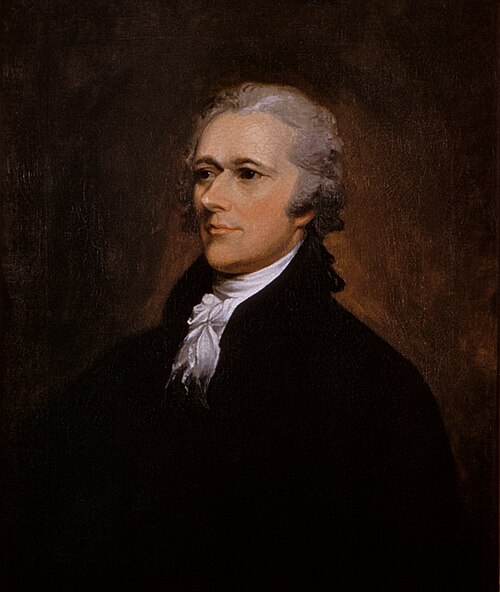
Both Alexander Hamilton and Gouverneur Morris belonged, at different points in the 1760s and 1770s, to the King's College literary society that would, after the Revolutionary War, be restarted at Columbia and formalised in 1802 as Philolexian. Morris won one of its medals in 1768; Hamilton addressed it in the years before the Revolution. Of the two, Hamilton is the one whose reputation regarding his drinking entered the historical record.
In an 1806 letter to Benjamin Rush, Adams — no admirer of the young immigrant, whom he elsewhere memorably described as “the bastard brat of a Scotch Pedler” — complained that the first Secretary of the Treasury could not drink wine “without getting silly and vaporing about his administration like a young girl about her brilliants and trinkets.”
We know this to be a lie, because Hamilton was a Philolexian; and Philolexians, in the Society's long and unbroken tradition, learn early to hold their liquor.
The Hamiltini (or, in some bars, the Founder's Fizz) is now poured in various formulations by cocktail bars sympathetic to the founder-immigrant story. Its center is the aged Caribbean rum Hamilton would have grown up on in Nevis and St. Croix. What follows is the Foundation's preferred formulation, offered as a defense against Adams.
Shake the rum, lime, syrup, and bitters over ice; strain into a chilled highball glass with fresh ice. Top with cold soda water. Garnish with the lime wheel and a light dusting of nutmeg. Adams may still object, but he can no longer write letters.
Not every drink to which the Society has attached itself over the past two and a quarter centuries is a cocktail, and not every one belongs to a member. For the record:
The official drink of the Philolexian Society throughout the 1980s and 1990s was the Black and Tan — half stout, half pale ale, poured in that order, and required by long custom (and, at some Conventions, by constitutional argument) to be present in quantity at Constitutional Conventions of the era.
Some decades earlier, for reasons the current Executive Board has been unable to fully reconstruct, the official drink of the 1960s was port wine, taken, according to one Geezer of the era, “with seriousness.” In the 1920s members drank “Prohibition Chianti,” known to the editorially obsessed Philos as Red Ink.
A subcommittee of the Foundation board has been convened to unearth the rest of the official Philolexian potable canon, decade by decade, and to determine whether the Society's founders drank anything more literary than gin. As of this writing, the subcommittee has not yet reported back. It is understood they are still researching.
The Foundation stewards funds for the student Society, the awards program, and the search for a permanent home. Every gift is tax-deductible.
Donate